


Ever tried to name a samurai character and froze? Or wondered what your own Japanese surname really says about your family?
Here you’ll find over 200 ancient Japanese last names with simple meanings. You’ll learn where they came from, how samurai clans used them, and which ones people still carry today. 🎌
You’ll also get tips to pick the right name for a story, a game, or your own research.
What Are Ancient Japanese Last Names?
Ancient Japanese last names are family names from the Yamato, Heian, and Sengoku eras. Most came from places, jobs, nature, or powerful clans.
Japanese names are written in kanji, so each surname carries a picture meaning. Take Tanaka. It means “middle of the rice field.”
Top Ancient Japanese Surnames at a Glance
These are the names you’ll meet most often in history books and family records:
- Sato: wisteria helper
- Suzuki: bell tree
- Takahashi: tall bridge
- Tanaka: middle rice field
- Watanabe: near the crossing
- Ito: Ise wisteria
- Yamamoto: mountain base
- Nakamura: central village
- Kobayashi: small woods
- Kato: added wisteria
- Yoshida: lucky rice field
- Yamada: mountain rice field
- Sasaki: Omi region clan name
- Yamaguchi: mountain mouth
- Matsumoto: pine base
The History of Ancient Japanese Surnames
Surnames began with the uji and kabane system over 1,500 years ago. Powerful families used clan names to show rank at court.
Most farmers and townspeople had no official family name for centuries. In 1875, the Meiji government ordered every commoner to pick one. Many chose a local landmark, which is why so many names mention fields, rivers, and hills.
Ancient Japanese Last Names from the Samurai Era
The samurai gave us the names everyone knows from battle stories:
- Oda: weaving field
- Toyotomi: bountiful minister
- Tokugawa: virtue river
- Takeda: warrior field
- Uesugi: upper cedar
- Date: dashing style
- Sanada: true field
- Mori: forest
- Shimazu: island harbor
- Hojo: north branch
- Akechi: bright wisdom
- Maeda: front field
- Asai: shallow well
- Imagawa: now river
- Chosokabe: Tosa clan name
- Kuroda: black field
- Ishida: stone field
- Kobayakawa: small fast river
- Hosokawa: narrow river
- Ukita: floating field
- Kamei: turtle well
- Hori: moat
Ancient Japanese Last Names from Feudal Japan
Feudal lords ruled whole regions, and their names often matched their land:
- Ashikaga: foot profit
- Nitta: new field
- Hatakeyama: field mountain
- Yamana: mountain name
- Akamatsu: red pine
- Kyogoku: capital’s edge
- Ouchi: great inside
- Otomo: great friend
- Satake: helping bamboo
- Mogami: highest river
- Nanbu: southern part
- Tsugaru: northern region name
- Soma: mutual horse
- Rokkaku: six corners
- Toki: Mino clan name
- Kikkawa: lucky river
- Amago: Omi clan name
- Miyoshi: three goods
- Matsunaga: pine eternal
- Hatano: wave many fields
Ancient Japanese Clan Names
Think of these as the “big four” and their old court cousins:
- Minamoto: source
- Taira: peace
- Fujiwara: wisteria field
- Tachibana: mandarin orange
- Soga: old court clan
- Mononobe: warrior keepers
- Nakatomi: middle minister
- Imbe: ritual purifiers
- Sugawara: sedge field
- Oe: big inlet
- Kamo: shrine clan
- Hata: silk weavers
- Yamato: great harmony
- Izumo: rising clouds
- Kibi: old western kingdom
- Miwa: three rings
- Haji: clay workers
- Sakanoue: above the slope
- Kiyohara: pure field
- Abe: peaceful
- Munakata: shrine family
- Katsuragi: vine castle
Ancient Japanese Last Names Inspired by Nature
Mountains, rivers, and trees fill old family records. These are easy to remember:
- Hayashi: forest
- Ishikawa: stone river
- Mizuno: water field
- Sakurai: cherry well
- Takeuchi: inside bamboo
- Shimizu: clear water
- Ogawa: small river
- Hoshino: star field
- Kitagawa: north river
- Umeda: plum field
- Kusano: grass field
- Iwasaki: rocky cape
- Tsuchiya: earth house
- Sugiyama: cedar mountain
- Takayama: tall mountain
- Hasegawa: long valley river
- Kawaguchi: river mouth
- Shirakawa: white river
- Fujita: wisteria field
- Nomura: field village
- Tanigawa: valley river
- Iwata: rock field
More Ancient Japanese Surnames Worth Knowing
Here are ninja families, Edo guardians, and late Edo heroes:
- Hattori: cloth weavers, home of Hanzo
- Momochi: Iga ninja line
- Fuma: wind demon
- Kuki: nine demons
- Kondo: near wisteria
- Hijikata: earth direction
- Okita: offshore field
- Saito: purifying wisteria
- Sakamoto: slope base
- Katsura: katsura tree
- Takasugi: tall cedar
- Kido: wooden door
- Saigo: west district
- Iwakura: rock storehouse
- Itagaki: board fence
- Honda: root of many
- Ii: well
- Sakai: liquor well
- Sakakibara: sacred tree field
- Okubo: big hollow
Ancient Japanese Last Names Still Used Today
Many old names never left. You may know someone with one:
- Inoue: above the well
- Kimura: tree village
- Yamazaki: mountain cape
- Ikeda: pond field
- Hashimoto: bridge base
- Ishii: stone well
- Yamashita: below the mountain
- Goto: behind wisteria
- Okada: hill field
- Murakami: village top
- Endo: far wisteria
- Aoki: green tree
- Ono: small field
- Fujii: wisteria well
- Nishimura: west village
- Fukuda: fortune field
- Ota: big field
- Miura: three bays
- Okamoto: hill base
- Nakajima: center island
Read More: Names That Mean Bunny: 380+ Sweet & Playful Ideas
How Ancient Japanese Surnames Changed Over Time
Early names showed rank. Later ones showed land. After 1875, they showed whatever a family picked.
Spellings shifted too. Old kanji got simpler, and some rare names faded. Still, many samurai family names kept their first writing, which is why they feel so old.
Ancient Japanese Last Names with Traditional Meanings
These names read like tiny poems:
- Harada: meadow field
- Kaneko: gold child
- Wada: harmony field
- Nakano: middle field
- Fujimoto: wisteria base
- Maruyama: round mountain
- Tamura: rice village
- Sugimoto: cedar base
- Kubo: hollow
- Chiba: thousand leaves
- Kikuchi: chrysanthemum pond
- Kojima: small island
- Nagata: long field
- Sawada: swamp field
- Tsuji: crossroads
- Arai: new well
- Miyazaki: shrine cape
- Takagi: tall tree
- Noguchi: field mouth
- Hirano: flat field
Read More: 300+ Demon Last Names: Dark, Rare & Mysterious Surnames (2026)
Ancient Japanese Last Names by Region
Names often point to home. I like to match them to a map:
Okinawa
- Higa: east
- Kinjo: gold castle
- Arakaki: new fence
- Oshiro: great castle
- Chinen: Okinawan village name
- Uehara: upper field
- Gushiken: southern Okinawan name
- Nakasone: middle root
- Shiroma: castle gap
- Miyagi: shrine castle
Kyushu
- Nabeshima: pot island
- Ryuzoji: dragon temple
- Sagara: mutual good
- Aso: named for Mount Aso
- Omura: big village
Kanto and Tohoku
- Utsunomiya: shrine town name
- Yuki: tied castle
- Nasu: plains region name
- Naoe: straight inlet
- Oyama: small mountain
Famous Ancient Japanese Last Names
History fans will spot these right away:
- Miyamoto: Musashi, the sword saint
- Yagyu: willow life, famed sword school
- Kamiizumi: founder of Shinkage style
- Tsukahara: Bokuden’s line
- Oishi: leader of the 47 ronin
- Asano: the lord they avenged
- Kira: the court official in that tale
- Konishi: Christian daimyo
- Fukushima: Hideyoshi’s spear general
- Todo: castle builders
- Shibata: Oda’s top retainer
- Niwa: Oda’s loyal ally
- Hachisuka: bee village
- Kusunoki: camphor tree, loyal warrior
- Akizuki: autumn moon
- Sakuma: Oda general
- Gamo: Hideyoshi’s ally
- Tsutsui: pipe well
- Wakisaka: Shizugatake spearman
- Yamaoka: mountain hill
Read More: Best Names That Mean Light in the Darkness: 300+ Ideas
Tips for Choosing an Ancient Japanese Last Name
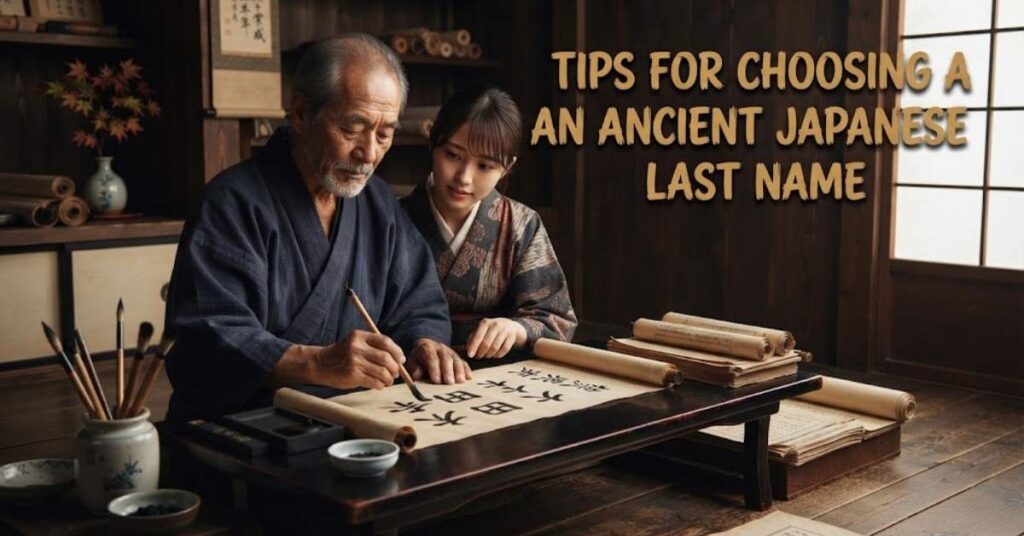
- Match the vibe. Warriors suit Takeda or Sanada. A gentle healer fits Sakurai.
- Pair it with a first name. Say it out loud. If it flows, keep it.
- Check the place. A Kyushu hero with an Okinawan name will confuse fans.
- Skip heavy clan names. Minamoto or Tokugawa can sound like royalty fast.
Frequently Asked Questions
What is the oldest type of Japanese surname?
Uji and kabane names came first. Clans like Soga and Mononobe used them to mark rank at court.
Can I use an ancient Japanese last name for a fictional character?
Yes. Many writers do. Just pick a name that fits your character’s region and era.
Are ancient Japanese last names still used in Japan today?
Yes. Sato, Suzuki, and Tanaka are among the most common surnames in Japan.
What makes a Japanese last name sound more traditional?
Look for nature words and place words, like mountain, field, or river. Those patterns are very old.
Is it okay to use a Japanese surname as a username?
Usually yes. Avoid names tied to real, living people so nobody gets confused.
Conclusion
You now have 201 ancient Japanese last names with plain meanings. You saw how clans, samurai lords, nature, and regions shaped them, and how the Meiji rule gave every family a name.
Pick one that fits your story, game, or research, and say it out loud. Which was your favorite? Drop it in the comments and tell us who you’d name with it! 🌸

Reyansh is a passionate content writer and name enthusiast who enjoys exploring name meanings, origins, unique naming ideas, and cultural connections. Through DigitalZeto, he creates simple, helpful, and engaging content to help readers discover meaningful names with confidence.